May 26, 2026
Meal Prep for Beginners: 5 Dinners in 2 Sunday Hours
Follow this single two-hour Sunday session and you will have five ready-to-assemble dinners waiting in your fridge by 2pm, without cooking anything twice.
By ChefDeck
· 12 min read

You don't need a whole weekend or a restaurant-size kitchen. One focused two-hour session on Sunday morning is enough to stock your fridge with five ready-to-assemble dinners before lunch is even over.
What You Will Actually Have Ready by 2pm
Before you commit to reading further, here's exactly what you'll be pulling out of your fridge each night this week. By the time you're done, you will have five distinct components — not five identical containers of the same dinner — sitting and ready to go:
- A batch of roasted chicken — bone-in thighs cooked until the skin is crisp, portioned into four servings
- A pot of cooked brown rice or farro, roughly three cups, plain and ready to absorb whatever flavors you throw at it
- A tray of roasted vegetables — bell peppers, onions, and zucchini — still slightly firm so they don't go mushy by Thursday
- A seasoned black bean mixture, cooked down with cumin and smoked paprika, that doubles as a protein extender and a filling on its own
- A simple two-sauce set: one bright (a lime-cilantro drizzle you shake together in a jar) and one rich (a store-bought BBQ sauce decanted into a squeeze bottle)
That's it. Five components, two hours, and you walk away with Monday through Friday covered. The rest of this post shows you exactly how to get there without the afternoon falling apart on you.
The One Meal Prep Rule That Keeps Beginners Going Past Week One
Most first-timers sit down with a list of five complete recipes and immediately feel buried. You're mentally cooking five separate dinners at once, and by the time the onions are softened you've already lost the thread. That's not a motivation problem — it's a structural one.
The fix is to stop thinking in meals and start thinking in components. A batch of roasted chicken isn't "Monday's dinner." It's a protein that can go over rice on Monday, inside a wrap on Tuesday, and reheated on a sheet pan with fresh sauce on Wednesday. The grain you cook on Sunday isn't "grain bowl night." It's a base that absorbs whatever flavor you put near it.
This is the foundation of meal prep that actually holds up past the first week. When you cook components instead of complete dishes, nothing feels repetitive, nothing gets wasted, and the Sunday session stays manageable because you're not chasing five separate finish lines at once. You're cooking five simple building blocks and letting the assemblies happen in ten minutes each evening.
If you want a deeper look at how this principle scales — including food safety timelines for keeping prepped proteins refrigerator-safe across a full work week — the meal prep schedule and food safety guide covers the specifics in detail.
Meal Prep Grocery List: 15 Items That Cover All 5 Dinners
A short grocery list isn't about being cheap or cutting corners. It's about choosing ingredients that show up in more than one dinner so nothing sits in your crisper drawer until it goes soft. Every item below pulls double duty across at least two of the five assemblies:
- 3 lbs bone-in, skin-on chicken thighs
- 1 lb boneless chicken breast or thighs (for the fajita strips)
- 2 cans black beans (15 oz each)
- 3 bell peppers (mixed colors)
- 2 medium zucchini
- 1 large yellow onion
- 1 bag brown rice or a box of farro
- 1 package large flour tortillas (8-count)
- 1 block sharp cheddar cheese
- 1 bottle BBQ sauce
- 1 lime (or a small bottle of lime juice)
- Fresh cilantro (one bunch)
- Olive oil
- Garlic (one head or a jar of pre-minced)
- Standard pantry spices: cumin, smoked paprika, garlic powder, salt, black pepper
For a household of two to four, this list typically runs $40–$55 at a standard grocery store — fourteen or fifteen items depending on what you already have on hand — and it covers five dinners plus leftover ingredients that roll into next week's shop. If you're cooking for a family of four on a budget, the black beans are your best friend here: a two-can batch costs under $3 and stretches across three of the five assemblies. The Smoky Black Bean Quesadillas require only pantry staples plus tortillas and cheese, making them the lowest-cost assembly of the week.
The Two-Hour Kitchen Schedule, Broken Into 15-Minute Blocks
Set a timer. Here's your sequence. The logic is simple: whatever takes longest goes in first, and you use the waiting time to do every cold task on the list.
- Minutes 0–15: Oven on, chicken in. Preheat your oven to 400°F. Pat your bone-in thighs dry, season with salt, pepper, and garlic powder, and slide them onto a rimmed baking sheet. These go in first because they need 25 minutes of hands-off time. While the oven heats, start your rice or farro on the stovetop according to package directions — it'll simmer unattended for the next 30–40 minutes.
- Minutes 15–30: Chop all your vegetables. Use this block to slice all three bell peppers, the onion, and the zucchini. Keep the bell peppers and onion in one pile (they become your fajita strip vegetables) and the zucchini in another (roasted vegetable component). This is the only chopping session of the morning — do it all now so you're not picking up a knife again.
- Minutes 30–45: Black bean mixture and fajita prep. Open and drain your cans of black beans. Warm a 12-inch skillet over medium heat with a splash of olive oil, add the beans with a minced garlic clove, a teaspoon of cumin, a half-teaspoon of smoked paprika, and a pinch of salt. Cook for 8–10 minutes until the liquid reduces and the beans are fragrant. Set aside to cool. Meanwhile, toss your sliced bell peppers and onion in olive oil and the same spice blend — these will go in the air fryer next.
- Minutes 45–60: Air fryer runs, first oven swap. Pull your chicken thighs out if they've hit 25 minutes — check that an instant-read thermometer reads 165°F at the thickest point. Set them on a wire rack to cool. Load the zucchini onto the now-empty baking sheet, drizzle with olive oil and salt, and slide it back in at 400°F for 15 minutes. At the same time, run your fajita strips. If you have an air fryer, the method in Air Fryer Chicken Fajita Strips with Bell Peppers and Onions takes 10 minutes of prep and 18 minutes to cook — queue them up now while the zucchini roasts in the oven.
- Minutes 60–75: Sauce assembly + rice check. Your rice should be about done or resting. Fluff it, spread it on a sheet pan for 5 minutes to steam off excess moisture before storing (this prevents clumping). While it cools, shake together your lime-cilantro drizzle: juice of one lime, a handful of chopped cilantro, two tablespoons of olive oil, a pinch of salt. Pour it into a small jar. Leave the BBQ sauce in its bottle — you'll use it as-is on Wednesday.
- Minutes 75–90: Air fryer finishes, everything comes to room temperature. Pull the fajita strips and let everything cool on the counter. Don't rush this step — putting warm food directly into sealed containers creates condensation, which shortens shelf life. This is a good time to label your containers with a marker.
- Minutes 90–105: Portion and store. Pack each component into its own container. See the next section for which containers work best and how to stack them.
- Minutes 105–120: Cleanup. One baking sheet, one skillet, one air fryer basket, one pot. Wipe down the counters. You're done.
If you want an alternate oven protein with more of a crust, Baked Parmesan Crusted Chicken has the same 10-minute prep and 25-minute bake time, so it slots into that first oven block without disrupting your schedule.
Beginner Meal Prep Storage: Keep Everything Fresh Through Thursday
Storage is where a lot of first-timers lose their prep. Soggy rice, rubbery chicken, vegetables that smell off by Wednesday — these are almost always container problems, not freshness problems.
Here's what to use and how to pack it:
- Chicken thighs: Store in a shallow airtight container, skin side up, with a folded paper towel underneath to absorb moisture. This keeps the skin from turning completely soft. Consume by Thursday for best texture.
- Rice or farro: A wide, flat container works better than a tall one — the grain stays loose instead of compacting into a brick. Press a sheet of plastic wrap directly onto the surface before sealing the lid.
- Roasted vegetables: Store in a vented container if you have one, or leave the lid slightly ajar for the first hour after refrigerating. Fully sealing hot vegetables speeds up sogginess.
- Black bean mixture: An airtight container, any size. This keeps well for five days and actually tastes better by Tuesday as the spices settle.
- Sauces: The lime-cilantro drizzle goes in a small mason jar (4 oz works). Shake before each use. The BBQ sauce stays in its original bottle.
Stack order in the fridge matters more than it sounds. Put the heaviest, most durable containers (beans, rice) on the bottom shelf. The chicken goes on the shelf above, where the temperature is most consistent. Vegetables and sauces go on the door or the top shelf where you'll see them and reach for them first.
One thing to keep separate until the night you cook: don't dress your grain or combine any components in advance. The minute the lime drizzle hits the rice, you've committed that portion to a specific flavor. Keep the sauces isolated and you preserve your flexibility for the whole week.
Turning Your Five Components Into Five Different Dinners
Here's where the week actually plays out. None of these take more than 15 minutes of active evening work.
Monday — grain bowl night: Scoop rice into two or four bowls. Add a portion of roasted vegetables and a spoonful of black beans. Slice one or two chicken thighs and fan them over the top. Drizzle with the lime-cilantro sauce. That's it — the components are already cooked, you're just building.
Tuesday — wrap night: Warm a flour tortilla in a dry skillet for 30 seconds per side. Pile in fajita strips, black beans, shredded cheddar, and a squeeze of BBQ sauce. Roll and eat. This is the Black Bean Chicken Wrap assembly in its simplest form — chicken, beans, and tortillas doing exactly what you prepped them to do.
Wednesday — sheet-pan reheat: Spread your roasted vegetables on a baking sheet and lay the remaining chicken thighs alongside them. Roast at 400°F for 10 minutes to re-crisp the skin and warm everything through. Serve over a small scoop of rice with BBQ sauce on the side. The skin recovers well under dry oven heat — it won't be quite Sunday-fresh, but it's far better than microwaving. (For reference, the same technique works with Crispy Air Fryer Chicken Thighs with Garlic Butter if you want to swap proteins next week.)
Thursday — quesadilla night: This is the lowest-effort night. Warm a skillet, build a quesadilla with the remaining black bean mixture and cheddar cheese inside a flour tortilla, press it flat, and cook two minutes per side until golden. Serve with the lime drizzle as a dipping sauce. Two components, one pan, ten minutes.
Friday — freestyle: By Friday you'll have odds and ends of whatever's left — a scoop of rice, a handful of vegetables, maybe a couple of chicken strips. Toss everything in a skillet with a little olive oil and garlic, scramble in an egg or two if you want, and call it a Friday stir-fry. No recipe required.
The Three Mistakes That Kill a Beginner's Second Attempt
The first session usually goes fine. It's the second Sunday where people fall off. These are the three specific points where it tends to go wrong:
Over-prepping proteins. Cooking six pounds of chicken when you only need three means you're eating chicken every single night in a desperate attempt not to waste it, and by Wednesday you hate chicken. Scale your protein to match three or four dinners, not the full week. Stick to the quantities in the grocery list above until you know your household's actual appetite.
Relying on one sauce for everything. If every dinner this week tastes like lime-cilantro, you'll feel like you're eating the same meal on rotation regardless of how the components are arranged. Two sauces — one bright, one rich — is the minimum to create perceived variety. Before your second prep session, add a third sauce, something creamy like a simple tahini or a store-bought ranch, and suddenly Tuesday's wrap and Thursday's quesadilla taste nothing alike.
Skipping the written plan. Showing up to Sunday prep without knowing which five components you're making is the fastest way to spend 45 minutes staring at the fridge. Write your five components and the grocery list the night before, not the morning of. Five minutes on Saturday saves an hour of mid-session confusion.
Your Week-Two Upgrade: One Swap That Doubles Your Variety
Once you've run through the first session and felt how smoothly the components approach works, the temptation is to repeat it exactly. That's fine for a week, but a single protein swap is all it takes to make the whole week feel new. Try BBQ Chicken Bites in place of the bone-in thighs — bite-sized pieces pan-seared with smoky-sweet sauce in about 25 minutes. The prep structure stays identical (protein in early, grain running simultaneously, vegetables roasting in the second half), but Monday's grain bowl and Wednesday's sheet-pan reheat taste like completely different meals. Your fajita strips and black beans stay the same, because they're the constants that tie the week together.
If you'd rather swap the grain, farro gives you a nuttier, chewier base that makes the same bowl feel more substantial; quinoa cuts the cook time down; white rice works better inside wraps and quesadillas. One change, same two-hour Sunday window, a noticeably different week of eating. Build the habit first, then rotate the ingredients — that's the whole system.
More from the blog
Jun 9, 2026
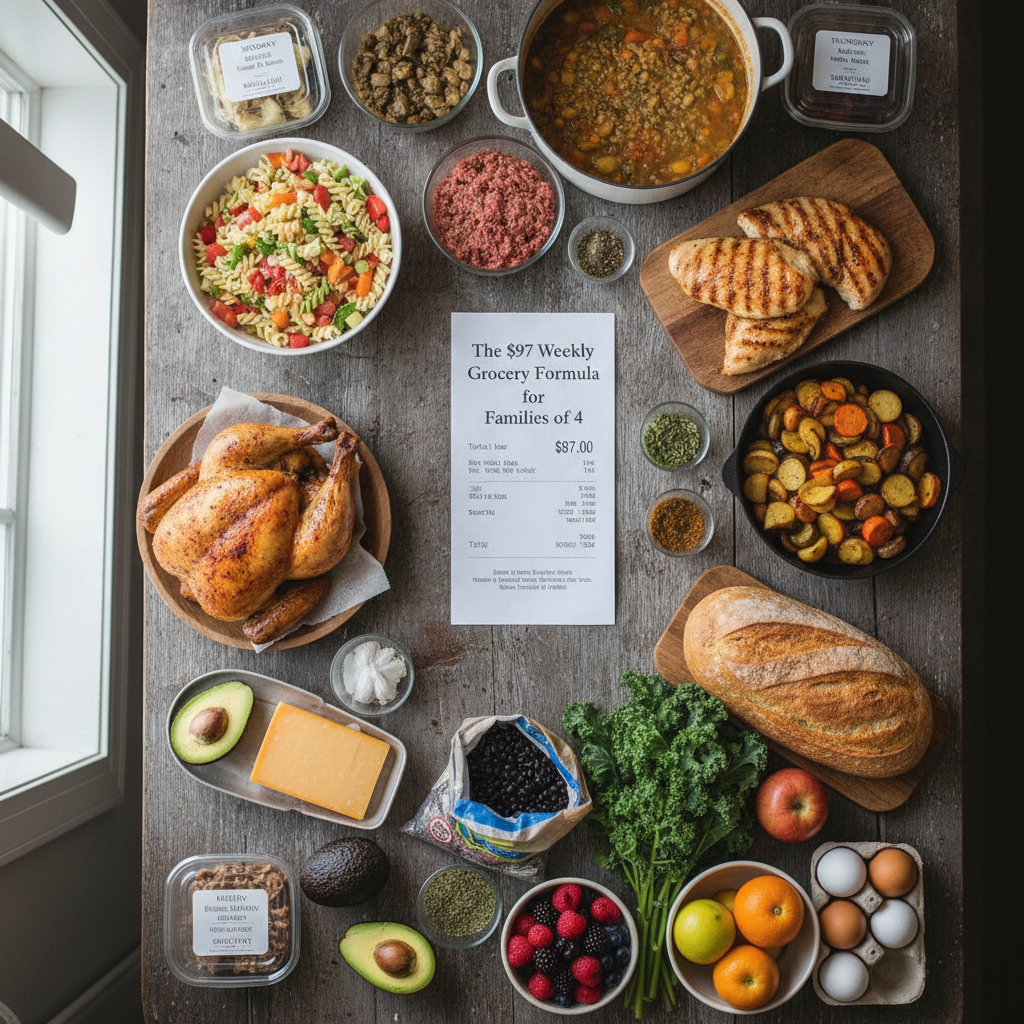
The $97 Weekly Grocery Formula for Families of 4
A repeatable weekly grocery formula, backed by a real $97 receipt, that feeds a family of four on under $100 without eating the same meals every week.
Jun 6, 2026
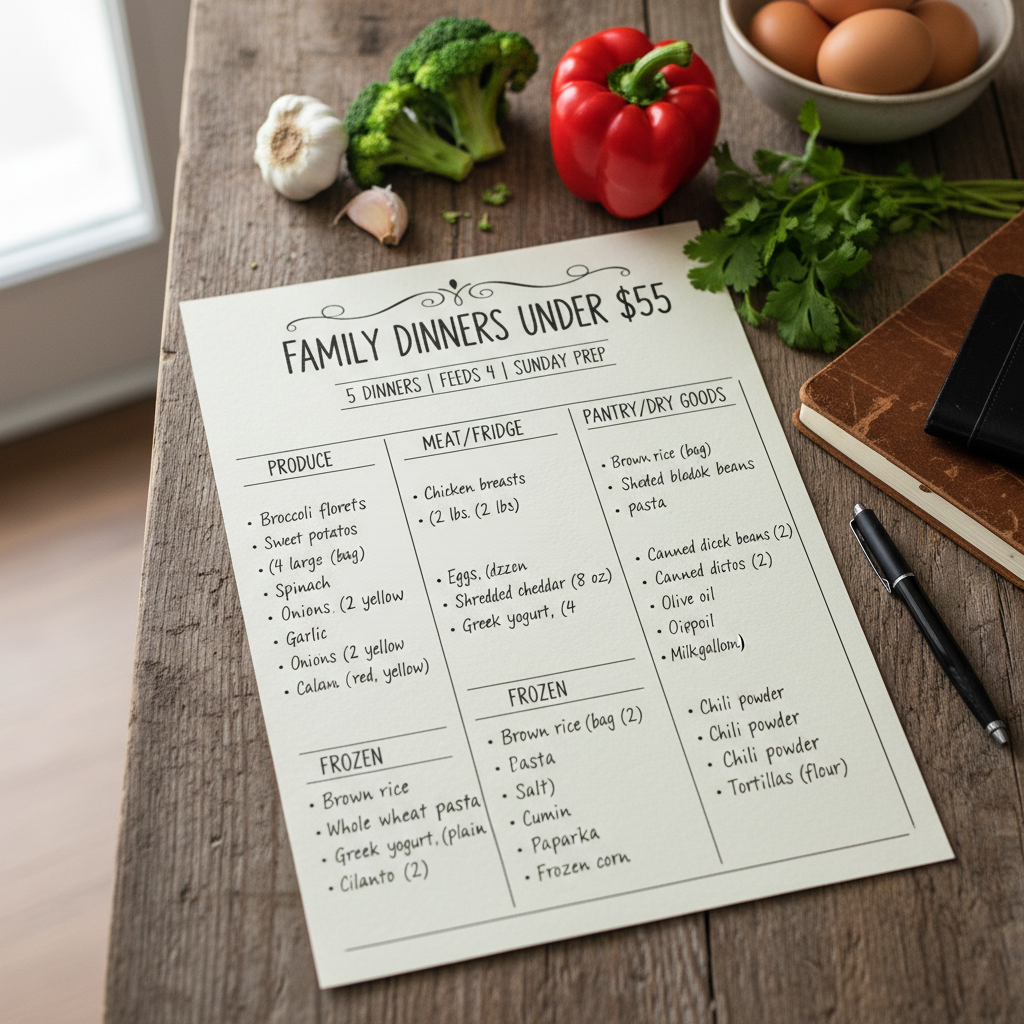
Meal Prep Grocery List Template for 5 Dinners Under $55
A ready-to-copy grocery list template, organized by store section, that cuts Sunday shopping time and keeps a family of 4 under $55 for 5 dinners.
Jun 5, 2026
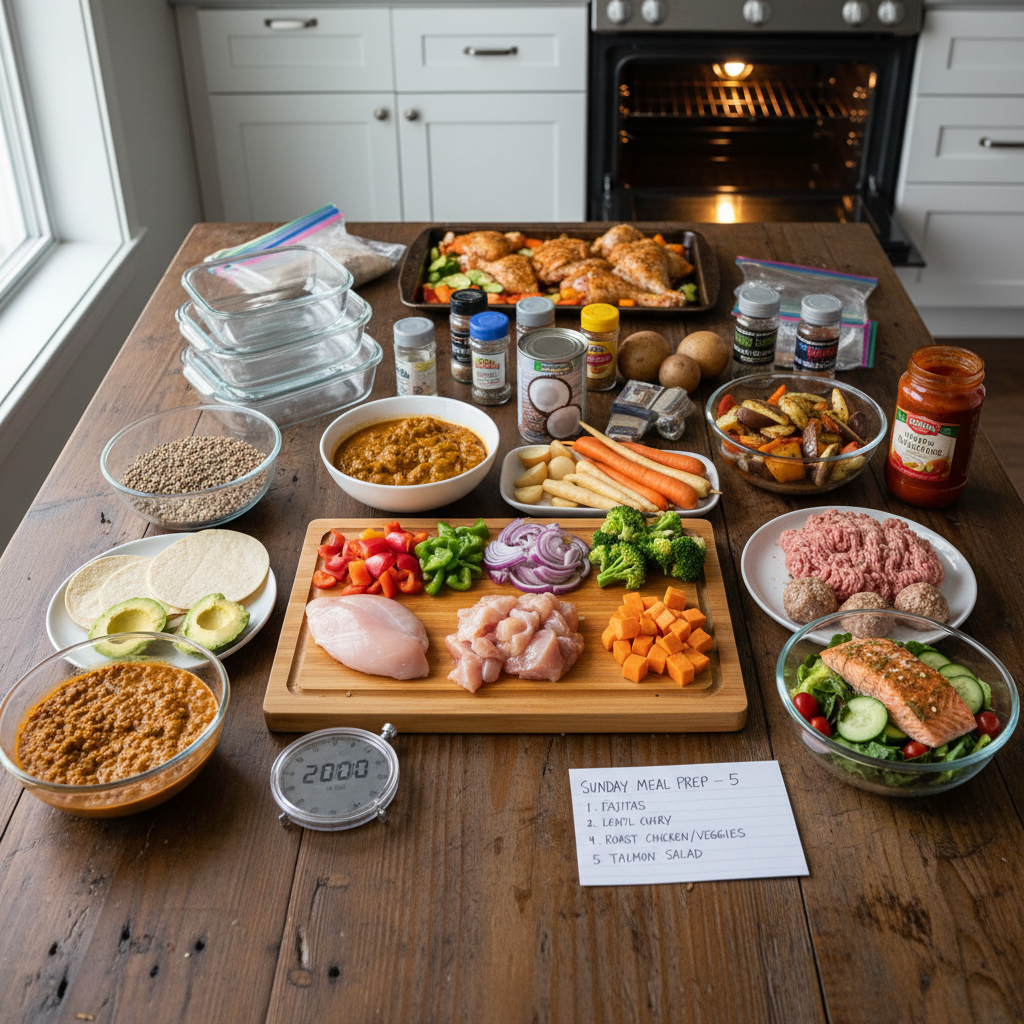
How to Meal Prep 5 Dinners in One Sunday Afternoon (2-Hour Routine)
Follow this timed two-hour Sunday routine — one oven, one burner, one cutting board — and walk away with five real weeknight dinners without a plan falling…
— Try ChefDeck free
Put this into practice this week.
Every new account starts with 14 days of Pro free — no card required.
Get started free